
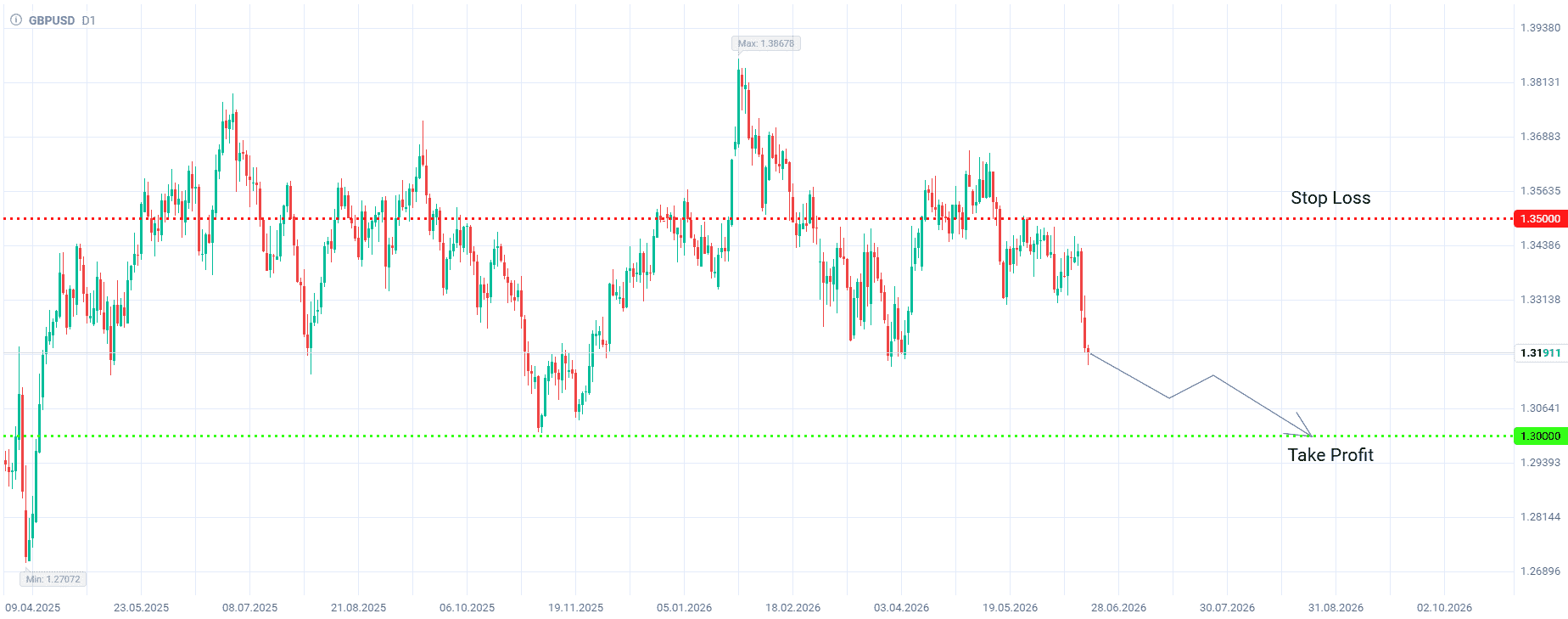
Over the past few days, GBPUSD has been under significant pressure. The pair’s decline was primarily driven by a toxic combination of a stronger dollar—bolstered by the June Federal Reserve (Fed) meeting—and the Bank of England’s (BoE) cautious stance, marked by no rate hikes amid lingering inflation risks.
This month, the British regulator kept borrowing costs unchanged at 3.75%, sending the pound lower, as the market considered such a decision not firm enough to curb the rising Consumer Price Index (CPI), which remains above the BoE’s target—particularly in the services sector. This reality leaves the central bank with little room to ease its monetary policy. At the same time, higher interest rates have already weighed on households, the mortgage market, and investment activity. As a result, the British regulator finds itself between a rock and a hard place. On the one hand, it must fight sticky inflation; on the other—avoid a critical economic slowdown. This is rather hostile environment for the pound, capping any recovery potential.
The greenback, by contrast, was underpinned by the outcome of the Fed meeting. The US central bank left interest rates at the same level (3.75%), but the updated dot plot revealed that some officials do not rule out a hike by year-end. The market response was swift: demand for dollar-denominated assets surged, dealing a heavy blow to GBPUSD. However, there is one more factor to take into account: geopolitical tensions. The recent de-escalation of the Middle East crisis has led to lower crude prices, which could limit future inflation expectations.
Taken together, these fundamentals point to a further decline in the pair. The nearest downside target could be the 1.30000 support level.
The ultimate recommendation is to sell GBPUSD at the current price, aiming for 1.30000 within a couple of weeks. To mitigate the risk of adverse market movements, place a Stop Loss order just above resistance, at 1.35000.