
AUDCAD is what investors call a “commodity cross”, as both of its constituent economies rely heavily on natural resource exports. Different trade baskets and diverging monetary paths make it a fascinating case for medium-term forecasting. But what really moves the pair? The answer is simple: a tug-of-war between the Reserve Bank of Australia and the Bank of Canada, as well as conditions across commodity markets.
The RBA is currently holding the line with a tight, hawkish stance. Stubborn domestic inflation is forcing the Australian regulator to keep interest rates at their peak. Consequently, traders are betting on borrowing costs staying high throughout this cycle. Meanwhile, the BoC has gone the other way, adopting a softer dovish position, with rates parked around 2.25%—a gap that puts the yield spread in the Aussie’s favor.
Still, this is not the whole story. In fact, the loonie is a pure “oil currency”. When Brent pushes above $98–$100 per barrel, fueled by Middle East tensions, it is a shot in the arm for the country and a cap on AUDCAD’s upside. The Australian dollar, by contrast, marches to the beat of iron ore and gold prices, as well as the pulse of Asia-Pacific economic activity.
There is one more layer to consider. Canada is closely tied to the US business cycle. Any hint of a slowdown in American consumption hits Canadian exports harder than those of Australia, which are geared toward Asian markets.
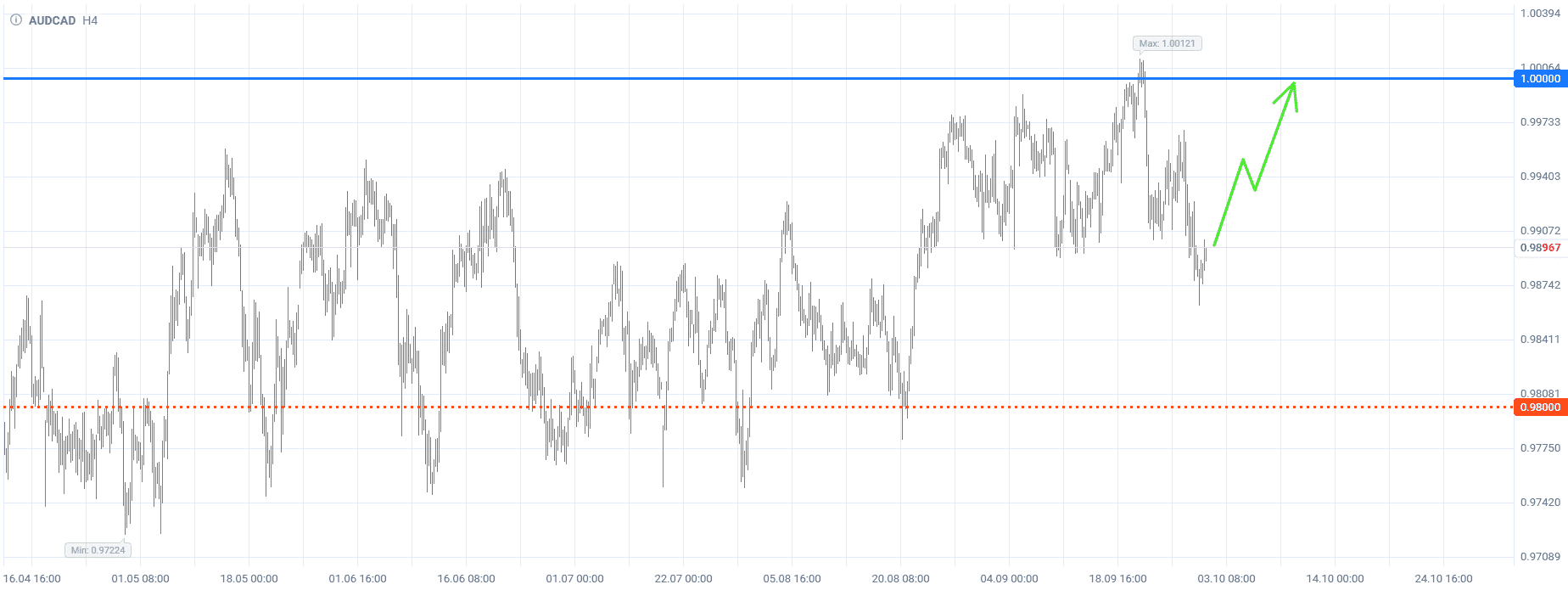
On the technical front, the pair has been locked in a wide horizontal channel for the past five months and is now hovering near its lower boundary, inviting bulls to step in.
The ultimate recommendation is to buy AUDCAD. Place Take Profit at 1.0000. Set Stop Loss at 0.9800.
Calculate your open position so that a potential loss (protected by a Stop Loss order) is limited to 1% of your deposit. If your account balance does not allow you to enter a position of this size, it is better to skip the trade and wait for other market signals that meet low-risk criteria.