
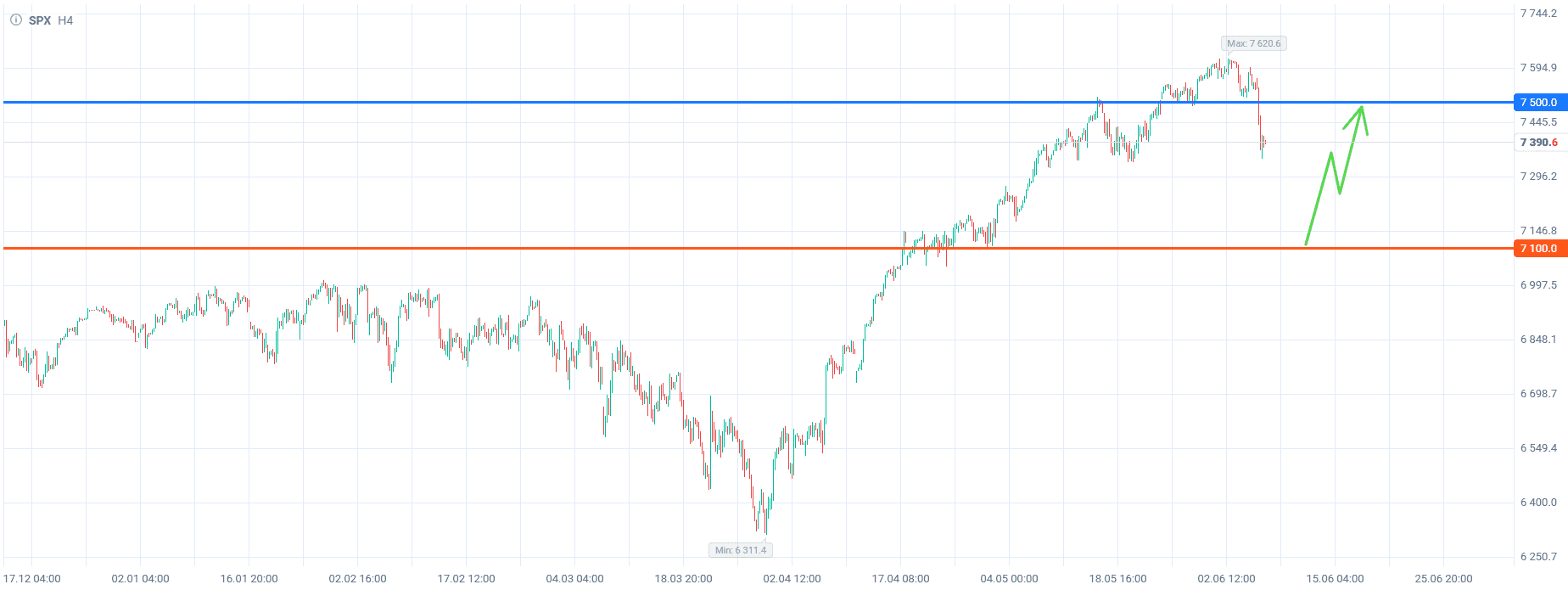
Friday’s blowout US employment report, which added 172,000 new jobs, sent bond yields rocketing higher and brought the S&P 500 Index (SPX) into a tailspin. The message from the market is loud and clear: the Federal Reserve (Fed) is not backing down anytime soon, and traders are finally waking up to this reality.
So, what comes next? The stage is set for high volatility and a bearish consolidation through June 2026. The index may test the support zone between $7,200 and $7,100 ahead of the Federal Open Market Committee (FOMC) meeting. Let’s be clear: the latest job data was a game‑changer, flipping short‑term investor expectations on their head. Strong job growth, combined with stubbornly high wage inflation, confirms that the economy is still boiling over—too hot for the Fed to pivot. As a result, the central bank will likely keep its foot firmly on the brake, much longer than markets had hoped.
Unsurprisingly, the immediate reaction was a sharp sell-off in the S&P 500 Index. Investors dumped risky assets across the board, fearing that the long-awaited midyear interest rate cuts might be delayed or eliminated entirely. To make matters worse, US Treasury yields spiked, thus adding another layer of pain for tech stocks and highly leveraged companies.
Looking ahead, all eyes are on the upcoming FOMC meeting. If the American regulator’s rhetoric remains hawkish—and all signs point that way—SPX will fall below its current support levels. From a technical standpoint, the picture suggests a possible test of the $7,200–$7,100 zone. The wild card, however, will be the Consumer Price Index report due mid‑month. Why does this matter? If inflation shows no signs of cooling despite a strong labor market, the panic exodus from stocks could turn into a stampede.
That said, the $7,100 level is a strong psychological floor. This is where long-term buyers may start licking their wounds and looking for entry points. The question is whether they will be brave enough to step up or step aside.
The ultimate recommendation is to buy SPX from the $7,100 threshold. Lock in profits at $7,500. Place Stop Loss at $6,900.
Calculate your open position so that a potential loss (protected by a Stop Loss order) is limited to 1% of your deposit. If your account balance does not allow entering a position of this size, it is better to skip the trade and wait for other market signals that meet low-risk criteria.